

The principle is applied in public. The assessment it rests on is not available.
In brief
- Between 13 and 19 August I submitted four freedom-of-information requests to the Ministry of Transport — 49 questions in total about the state's financial risk in AS Air Baltic Corporation. All were based on Sections 2 and 10 of the Freedom of Information Law, signed with a secure electronic signature and delivered to the official electronic address with delivery identifiers.
- By letter No. 03.2-02/2521 of 20 August the ministry forwarded the requests to airBaltic itself "for consideration on the merits and for a reply". The addressee of the letter is the company; I am listed only "for information". On 22 August I filed formal objections. On 24 August I published the procedural chronology on LinkedIn, Facebook and X. On 26 August the ministry announced by e-mail that a reply would be given within one month — under a provision of the Law on Submissions. That is the opposite position to the one taken in the letter of 20 August. On the same day I filed a procedural request for clarification (P1–P5).
- While the dispute over the applicable law continues, on 25 August the government took a decision that rests directly on the market economy operator principle — that is, on the very assessment I am asking about and am not allowed to see.
- Continuation (26 September). Three more requests were submitted in September — 68 questions in total. On 14 September airBaltic entered reorganisation under Chapter 11 of the US Bankruptcy Code; the bondholders' meeting was cancelled. The State Treasury and the ministry do not answer the questions about the state's mandate and exposure on the merits, citing neither a legal provision nor a route of appeal. The questions move to what happens to public money in the reorganisation. Read the continuation ↓
- Update (2 October). For the first time the State Treasury gives figures: the state's bond claims as of the Chapter 11 filing date are EUR 52.4 million, and the outstanding state loan is EUR 18.6 million. It still does not name the authorising decision and says it has "no documents". On the same day the Ministry of Transport left questions 50–68 unexamined, citing "exercise of rights in bad faith", and announced it will not reply to similar submissions. Read ↓
- Update (10 October). Public US court records show what Latvian authorities do not disclose: the company affirms under oath that an ex ante assessment was made for the state loan; the state loan is unsecured and subordinated; the new lenders' terms provide for government equity and exit financing by around 12 January 2027; the state is not on the creditors' committee.
- Update (12 October). The State Treasury confirms that on 24 September Latvia applied to join the unsecured creditors' committee but was not appointed — Tallinn and Lithuanian airports sit on it, Latvia does not. The State Treasury refuses to disclose the carrying value of the state's claims, citing trade secrecy. Read ↓
- Update (12 October, airBaltic). airBaltic confirms that it sent the Labour Law notice of staff reductions to the State Employment Agency and Mārupe Municipality on 29 September — four days before the Saeima election. It announced the reductions publicly on 5 October. Read ↓
- Update (14 October, Mārupe). Mārupe Municipality confirms that airBaltic's collective redundancy notice was registered on 30 September, states up to 700 employees, and the reduction is planned from 29 October. Read ↓
Context
On 11 August 2026 airBaltic announced a new business plan: the fleet is to be cut from 54 to 36 aircraft by the end of the year, with a gradual increase to around 40 aircraft in 2031. The previous plan for one hundred aircraft is no longer in force.
Funding need: EUR 225 million of interim financing, to be secured by the same collateral package that currently secures the 2029 bonds. In the longer term — recapitalisation with EUR 225 million of new borrowing and EUR 100 million of new equity; part of the existing 2029 bonds to be converted into shares, the remainder to be replaced with new, smaller debt of up to EUR 125 million.
On 17 August a reconvened bondholders' meeting approved the capitalisation of the coupon payments due on 14 August and 14 November — the interest is added to the principal rather than paid in cash — and a temporary waiver of the minimum liquidity requirements until November 2026.
On 20 August the Saeima adopted, under the urgency procedure, the Law on Financial Stabilisation Measures for Air Baltic Corporation AS. 54 members voted in favour, 21 against, one abstained. The President promulgated the law on 25 August and it entered into force on 26 August.
On 25 August the Cabinet of Ministers endorsed the Ministry of Transport's information report, deferring payment of the outstanding state-loan principal of EUR 18 million, the interest and the deferral fee until 30 December 2026, while keeping the 2% annual deferral fee.
Three roles in one hand
The analytical core of the campaign is this: in relation to airBaltic the state is simultaneously shareholder, bondholder and lender.
That is not my interpretation. Those are the legislator's own words. The statement of the Saeima Budget and Finance (Taxation) Committee on the bill says that its purpose is to give the state, as airBaltic's shareholder, creditor and bondholder, the ability to take timely decisions in the company's financial stabilisation process and to act on an equal footing with the other investors and creditors.
The same wording recurs in the Ministry of Transport's statement of 25 August: the state, as shareholder, creditor and bondholder, retains the ability to defend its interests in a coordinated way, on equal terms with other market participants.
Why that is a problem. Each role calls for the opposite course of action:
-
Shareholder
Has an interest in the company's survival at any price, because in insolvency its position is last in line.
-
Creditor
Has an interest in recovering its claim — if necessary, at the shareholder's expense.
-
Bondholder
Votes on the restructuring of its own claims together with other holders, whose interests may lie in the opposite outcome.
When one institution holds all three positions, it votes on its own claim, evaluates its own decision and confirms to itself that it has acted as a market participant. It is precisely this last step — the market economy operator principle (MEOP) assessment — that is the cornerstone of EU state-aid rules. If the assessment is not published, it cannot be verified.
This is not an accusation of a scheme. It is a flaw in the governance structure that creates a systemic conflict of interest regardless of the intentions of the people involved. That is how I put it in every request.
What was asked
| Request | Date | Questions | Delivery |
|---|---|---|---|
| Main request | 13.08.2026, 21:13 | 1–30 | e-address, OEAL-1104534520 |
| First supplementary | 15.08 (e-mail) / 19.08, 05:44 (duplicate via e-address) | 31–38 | Ministry of Finance reg. No. 2026/9785 |
| Second supplementary | 18.08 / delivered 19.08, 05:44 | 39–44 | e-address, OEAL-1104845810 |
| Third supplementary | 19.08, 22:14 | 45–49 | e-address, OEAL-1105000891 |
The questions by block
- 1–5 Liquidity and paymentsThe coupon payment, the State Treasury's vote, repayment of the state loan, the cash position, the bond reserve account.
- 6–12 Funding structureWho provides the 225 million, on what terms, what its priority is against the existing bonds, at what valuation the conversion takes place, what the state's shareholding will be afterwards.
- 13–16 Total exposureHow much the state is risking in total, how much it considers recoverable, where the risk ceiling is, how the conflict of interest is managed.
- 17–19 EU lawCompliance with the "one time, last time" principle, the MEOP assessment, communication with the European Commission.
- 20–25 Business planWhich routes are to be closed, what happens to the ACMI segment, how contracts with lessors are to be resolved, the impact on the airport and air traffic.
- 26–30 Oversight and accountabilityMeasurable interim indicators, the consequences of missing them, responsibility for the 2024 issue at a 14.5% coupon.
- 31–38 Cabinet decisions of 14 AugustThe terms of the additional bond purchase, the loan extension, availability of the information report.
- 39–44 Consequences of the 17 August meetingHow the State Treasury voted on each item, on what basis the state agreed to the capitalisation of its own interest, how that is reflected in the accounts.
- 45–49 Holder structure and control risksResults of the holder identification, the EUR 506 million valuation of the collateral assets, assessment of a loan-to-own scenario, the MEOP test before the EUR 50 million purchase in 2024.
Every request contains the same proviso: if a reply is barred by commercial secrecy or ongoing negotiations, please cite the specific legal provision, the date after which the information will become available, and whether it can be provided to a Saeima committee in closed session.
The ministry's reply: forwarding to the company
Letter No. 03.2-02/2521 of 20 August 2026, signed by the State Secretary, received at the e-address on 21 August at 08:17. Content: citing Section 4(1) of the Law on Submissions, the ministry forwards the submissions to AS Air Baltic Corporation for consideration on the merits and for a reply. At the same time the ministry asks the company to inform the ministry of the reply given.
Two objections.
First — a law was applied that does not cover these documents. Section 2(2) of the Law on Submissions provides that the law does not apply to information requests that are to be examined under the Freedom of Information Law. All four documents are expressly based on Sections 2 and 10 of the Freedom of Information Law.
Second — forwarding to an entity that is not a public authority. Even if the Law on Submissions applied, its Section 4(1) permits forwarding only to another competent authority. A joint-stock company to which no public administration tasks have been delegated in the relevant field is not an authority within the meaning of that law, and it has no statutory duty to answer a private person's information request. Forwarding to an entity with no duty to reply is, in substance, a refusal to examine the requests — without drawing up the refusal in a form that could be challenged.
And the practical argument, which is not a legal one. The company objectively cannot answer:
- how the State Treasury voted at the meeting of 17 August and on what basis;
- what the Cabinet of Ministers decided at its extraordinary closed sitting on 14 August;
- whether and who prepared the MEOP assessment and whether there has been any communication with the European Commission;
- what the state's total financial exposure is and where the risk ceiling lies.
These are state decisions, state documents and state accounts.
An additional circumstance. The letter is dated 20 August — the same day the Saeima adopted the airBaltic financial stabilisation law, which lays down a special procedure precisely for the state's participation in this process and obliges the Cabinet of Ministers to report quarterly to the Saeima Budget and Finance (Taxation) Committee.
On 22 August at 09:21 I filed formal objections with a renewed request for replies on the merits. Copies for information — to the Ministry of Finance, the State Treasury and the Saeima Budget and Finance (Taxation) Committee.
The second contradiction: the notice of 26 August
On 26 August 2026 at 09:34 a notice arrived from the ministry's e-mail address: under Section 5(3¹) of the Law on Submissions, the reply to the "information request" would be given within one month. The notice gives no registration number, author or signatory.
There are three separate problems here.
Irreconcilable positions. The letter of 20 August rests on the premise that it is for the company to reply. The notice of 26 August rests on the opposite premise — that the ministry will reply and the time limit runs at the ministry. Both cannot be in force at the same time. If the questions are outside the ministry's competence, it does not count a time limit. If it counts one, there was no basis for forwarding.
Classification versus consequences. The ministry itself calls my documents information requests, yet sets the time limit under a law which, by its own Section 2(2), does not apply to information requests.
An exception invoked without an established ground. In the version in force since 1 March 2026, Section 5(3) of the Law on Submissions sets the general time limit — no later than 10 working days. The one-month period under Section 5(3¹) is an exception, applicable only where additional information must be obtained, cooperation with other authorities is needed, or a large volume of information must be analysed. The notice does not say which of these three grounds was established. Only the provision is cited.
The choice has consequences. Section 10(5) of the Law on Submissions provides that matters arising from Section 5(3¹) are not subject to judicial review. The Freedom of Information Law contains no equivalent exclusion. The choice of applicable law therefore directly determines whether the requester retains any legal remedy.
On 26 August I filed a procedural request for clarification with five questions (P1–P5) — on the status of the 20 August letter, on the ground established, on the applicable law, on the date from which the time limit runs for each of the four documents, and on the registration numbers. Requested reply time — five working days.
This document does not withdraw the objections of 22 August.
Why it matters right now
While the dispute over which law applies to my questions goes on, decisions are being taken.
On 25 August the Cabinet of Ministers endorsed amendments to the April state-loan agreement. The ministry's statement says expressly that the amendments will be made in accordance with the market economy operator principle and in application of the state-aid rules. The same statement confirms that the State Treasury will continue to represent the state as bondholder and take part in future meetings, supporting the measures approved by the government.
That means the following. The state publicly invokes the market economy operator principle as the legal basis for its actions — and at the same time refuses, or defers by a month, its answer to the questions of who prepared that assessment, by what method, with what conclusion, and whether the European Commission was informed (questions 17–19, 33, 40 and 49).
The principle is applied in public. The assessment it rests on is not available.
The second circumstance concerns sequence. The State Treasury voted at the bondholders' meeting on 17 August, agreeing to the capitalisation of its own interest income. The law laying down a special procedure for the state's participation in this process was adopted on 20 August. The vote took place before the law. That in itself does not mean unlawfulness — the government's authorisation to the State Treasury had been given earlier, at the end of July — but it does mean that the structure of the state's claim was changed before the parliamentary framework that now governs such decisions.
Publications
On 24 August at 07:30 I published the procedural chronology on three channels: LinkedIn, Facebook and X (a thread of nine posts). Content — the delivery record of the requests, the 20 August letter, both legal objections, and a comparison with the Ministry of Finance's conduct (which, having received the same documents for information only, confirmed registration both times — on 17 August under No. 2026/9785 and on 20 August under No. 2026/9999).
This article is the canonical version. The social-media posts are pointers to it.
What is not known
An honest list.
- How the State Treasury voted on each item of the 17 August agenda separately. It is known that decisions were taken; the content and reasoning of the state's vote have not been published.
- Whether a MEOP assessment exists in writing at all for each individual step — the April loan, its extension, the capitalisation of interest, the planned purchase of additional bonds.
- Whether and when there has been communication with the European Commission.
- The company's valuation (pre-money valuation) at which claims will be converted into equity, and who is carrying it out.
- The state's total exposure in a single figure after all the August decisions are implemented.
- The parameters circulating in the public domain — a reduction of the state's shareholding to 25% plus one share and a total recapitalisation of EUR 325 million — have no primary source. In my question 43 I flagged them expressly as unconfirmed and asked for them to be confirmed or refuted. The law itself sets different limits: purchase of newly issued bonds up to EUR 30 million, conversion of the bond claims held by the state up to EUR 50 million.
The figures cited in this article come from public sources. If any of them is inaccurate, I will correct it and mark the correction.
What comes next
- A reply to the procedural questions P1–P5.
- The ministry's position on the applicable law — on which depends whether a refusal can be challenged in court at all.
- Replies on the merits to questions 1–49.
- The Cabinet of Ministers' first quarterly report to the Saeima Budget and Finance (Taxation) Committee under the new law.
- The actual terms of the interim-financing transaction and whether the state takes part in it on identical terms with the private investors, as publicly claimed.
If replies are not given, or a refusal is not drawn up in the manner prescribed by the Freedom of Information Law, I will use the right under Section 15 of that law to challenge the authority's decision and its actual conduct.
Continuation — 26 September 2026. Since the first version of this article, three more requests have been submitted, the ministry has given its first reply on the merits, and airBaltic has entered insolvency reorganisation in the United States. Below — in the order in which it happened.
From 49 to 68 questions
| Request | Date | Questions | Addressee |
|---|---|---|---|
| Fourth supplementary | 06.09.2026 | 50–57 (+ P6) | Ministry of Transport; State Treasury (directly: 50, 52, 56) |
| Fifth supplementary | 11.09.2026 | 58–61 (+ P7) | Ministry of Transport; State Treasury |
| Sixth supplementary | 22.09.2026 | 62–68 (+ P8) | Cabinet of Ministers (State Chancellery); Ministry of Transport |
Lines of questioning
- 50–52 The state's position in the voteWhat mandate the State Treasury was given for the bondholders' meeting, at which Cabinet sitting it was approved, whether the state will take part in the new issue and on identical terms with the private lenders.
- 53–55 The market operator principle at a known priceHow the state's 2% deferral fee complies with the market economy operator principle when the market, for the same debtor in the same period, demands 25% a year in a senior position.
- 56–57 Total exposureThe state's total financial risk in a single figure and by position; how much it considers realistically recoverable.
- 58–61 The postponed meeting and the mandateAfter the meeting was postponed and the government took no decision.
- 62–68 Consequences of Chapter 11The state's authorisation, position, recoverability and new liabilities under reorganisation.
The first reply on the merits — and its limit
On 4 September 2026, by letter No. 03.2-02/2658, the ministry for the first time replied on the merits to part of questions 1–49. Replies to the questions on the price, term, collateral, priority and lenders of the interim financing (6–12, 31) were refused on the ground that this is inside information within the meaning of Regulation (EU) No 596/2014, "which may not be disclosed to an individual person before it is announced to the market". Question 47 (priority of the new financing over the state's position) was refused as a commercial secret; on question 48 (change-of-control scenario) the ministry stated that no assessment had been carried out.
A problem of timing. The letter was signed on 4 September — the day after airBaltic itself, on 3 September, publicly announced to the market an agreement on interim financing of up to EUR 257 million (senior bonds, 25% a year, maturing in February 2027; lenders Polus Capital Management and Klirmark Capital 4). The letter also gives no route of appeal. Procedural request P6 points to this contradiction.
What was refused as "inside information before announcement to the market" had already been announced to the market.
Two events that rearranged the questions
A meeting postponed, then gone. The bondholders' meeting originally scheduled for 11 September was moved to 15 September — the chairman of the supervisory board, Andrejs Martinovs, explained that holders needed more time to study the draft decision. On 8 September the Cabinet of Ministers took no decision on the state's participation in the bridge financing; Minister of Transport Rihards Kozlovskis said that "the question of a possible state investment is not currently on the agenda".
Chapter 11. On 14 September 2026 AS Air Baltic Corporation filed a petition for financial reorganisation under Chapter 11 of the US Bankruptcy Code in the US Bankruptcy Court for the Southern District of New York (case No. 26-12188, Judge Lisa G. Beckerman). Public statements mention a debtor-in-possession financing commitment of around EUR 350 million (Strategic Value Partners, Barclays, Hayfin Capital Management, Morgan Stanley, Oaktree Capital Management); the process could run until around June 2027; flights are said to continue as normal. The planned bondholders' meeting was cancelled and the vote on the bridge financing did not take place.
In Latvia's information space this was confirmed not by a ministry statement but by the State Treasury's reply to my request.
The State Treasury's reply — and why it does not answer
On 22 September 2026, by letter No. 2026/3-5.19/899, the State Treasury replied to questions 50, 52 and 56, which were addressed to it directly. The core of the reply: (a) the factual circumstances have changed — airBaltic has entered the Chapter 11 process, the meeting has been cancelled, no vote has taken place; (b) the State Treasury acts solely within the authorisation given by the Cabinet of Ministers; (c) information is provided subject to access restrictions.
The substance of the questions — how it voted, what the exposure is, what the mandate is — is not answered. As in the ministry's letter of 4 September, here too no specific legal provision is cited for each unanswered question and no route of appeal is given, as the Freedom of Information Law requires.
But the main news is the news itself: public money — share capital, bonds, a loan — is tied up in a company that has passed into insolvency reorganisation in another country's jurisdiction.
The questions do not disappear. They move to what happens to public money in the reorganisation.
The sixth request: consequences of reorganisation
On 22 September I submitted the sixth supplementary request, this time addressed to the Cabinet of Ministers (State Chancellery) and to the Ministry of Transport as holder of the state's shares.
- 62 AuthorisationWhich specific Cabinet decision (number, date, minute item) the actions of the State Treasury and the ministry rest on.
- 63 Government decisionsWhen and by what decision the government has decided, or will decide, on the state's conduct in the Chapter 11 process.
- 64 30 millionThe status of the state participation provided for in the law after the cancellation of the meeting — implemented, deferred or withdrawn.
- 65 ExposureThe state's total risk after Chapter 11 — in total and by position, with carrying value and recognised impairment.
- 66 Priority and recoverabilityHow the process affects the state's claims as bondholder and lender; whether an assessment has been made.
- 67 The 18 million loanThe balance due on 30.12.2026 — to be collected, rolled over or written off.
- 68 New liabilitiesWhether the state has assumed or plans to assume new financial liabilities in connection with the reorganisation or refinancing; if so, in what amount and by which decision.
Procedural request P8 again asks for replies on the merits to the questions previously left unanswered (including 6, 7, 9, 31, 47 and 50–61) insofar as the information is no longer restricted since its announcement to the market or the change in circumstances.
The State Chancellery's reply (25 September). The request was also addressed to the Cabinet of Ministers, but I sent it via the e-address marked "copy". On 25 September the State Chancellery replied by letter No. 6.2.2./2026-FIZ-904-3015 that the Ministry of Transport develops and coordinates aviation policy and is the holder of the state's shares in airBaltic; since the request to the Cabinet had been sent for information and simultaneously to the ministry, the State Chancellery would not forward it and its content "is taken note of". The reply on the merits to questions 62–68 is therefore expected from the Ministry of Transport — within the time limit set by Section 14 of the Freedom of Information Law: 15 days (around 7 October) or, if the information requires additional processing, 30 days.
The State Treasury's second reply: the first figures
On 2 October 2026, by letter No. 2026/3-5.19/931, the State Treasury replied to my clarification request of 22 September. For the first time the reply contains specific figures on the state's claims against airBaltic.
The rest of the reply repeats the previous one: the state's position is set by the Cabinet of Ministers, the vote on interim financing did not take place, so there is "no additional information to provide". On the 17 August vote, the State Treasury writes that it "acted within the authorisation given to it", but again does not name the authorising decision. The reply ends by stating that the State Treasury has "no documents to submit".
The State Treasury also states that its 22 September reply did not refuse any information. That means there is no refusal and so nothing to appeal, but there is no answer on the merits either.
So on 2 October I submitted two short requests. To the State Treasury (P9): which Cabinet decision gave the mandate on 17 August (before the stabilisation law was adopted on 20 August), how the State Treasury voted, what the EUR 52.4 million consists of, whether the state's claims have been filed in the US court, and what their carrying value is. To the Cabinet of Ministers (P10), this time as a request rather than a copy: on the authorising decisions, the state's action in the Chapter 11 process, and the EUR 18 million loan after 30 December.
The ministry stops answering
On the same day, 2 October, the Ministry of Transport replied to the requests of 6, 11 and 22 September (questions 50–68 and procedural requests P6–P8) by letter No. 03.2-02/2951, signed by State Secretary Andulis Židkovs. There are no answers to the questions. The ministry "leaves the submissions without further examination".
The letter was signed by a State Secretary who is about to move to another post: on 18 June the Saeima appointed Andulis Židkovs to the board of the Public Utilities Commission, where he starts on 19 October (LSM). A competition for the post of State Secretary of the Ministry of Transport has been announced.
The basis given is Section 7(1), points 5 and 7, of the Law on Submissions: an answer has allegedly already been given in the letter of 4 September, the circumstances have not changed, and the requester is exercising his rights in bad faith. The ministry refers to Supreme Court case law that the number and frequency of submissions can indicate this. It writes that "the numbering of questions continued up to question 68" and that answering would "require a disproportionate use of the Ministry of Transport's resources". For the new circumstances, including Chapter 11, the ministry suggests looking in the official statements of institutions and airBaltic.
The letter ends with a warning: if the ministry receives a submission of similar content, it "will take note of it and will not reply".
The State Treasury says: the state's position is set by the Cabinet. The State Chancellery says: ask the Ministry of Transport. The Ministry of Transport says: stop asking.
Comment. There are many questions; that is true. But their number grew because the first ones were not answered on the merits, and because the situation changed: while the ministry was preparing its 4 September reply, airBaltic was not yet in reorganisation. Questions about the consequences of Chapter 11, the recoverability of the state's claims and the EUR 18 million loan after 30 December could not have been asked on 4 September, so they could not have been answered either.
Four legal objections:
- Once again a law has been applied that does not cover these documents. Section 2(2) of the Law on Submissions states that the law "does not apply to information requests that are examined in accordance with the Freedom of Information Law". All the requests are based on the Freedom of Information Law. It is the same error as in the 20 August letter that forwarded the requests to airBaltic.
- The Freedom of Information Law has its own ground for refusal, but it was not used. Section 11.2(3) allows a refusal where a request is not proportionate to the institution's resources. The ministry's letter almost paraphrases it, but cites a different law.
- The letter does not say where and within what time the decision can be appealed. Section 12(1) of the Freedom of Information Law requires this. Point 21 of the Ministry of Transport's by-laws provides that the State Secretary's administrative acts are appealed to a court, and in that case Section 188(3) of the Administrative Procedure Law extends the time limit to one year.
- The warning about future requests rests on the same Law on Submissions. The Freedom of Information Law contains no provision allowing an institution to announce in advance that it will not answer future requests; each request has to be assessed when it is received.
In fairness: the ministry's main argument is not purely formal. The Supreme Court has repeatedly stressed that the right to request information must also be exercised in good faith, and has set out criteria for assessing bad faith. So the question of whether there are too many requests is legitimate in itself. But in this case those criteria have to be applied to the actual circumstances: the questions concern more than EUR 70 million of state claims in a company that has entered reorganisation in another jurisdiction; some of them arose after the ministry's reply; and they are asked by the editor of a registered media outlet to inform the public.
Whether this decision is lawful will now be for a court to assess. I am preparing an application to the Administrative District Court.
What the US court knows
On 2 October the Ministry of Transport suggested looking for the new circumstances in the official statements of institutions and airBaltic. There is another public source: the records of US Bankruptcy Court case No. 26-12188, available to anyone. I have read them. What follows is only what they say, with the docket number (Dkt.) and page. Where something is one party's claim rather than a fact, that is stated.
An assessment of the state loan exists, at least according to the company. The declaration of CFO Vitālijs Jakovļevs, filed with the court on 14 September under penalty of perjury (Dkt. 14, p. 27), states that the state loan was granted on commercial terms after an ex ante assessment of the company's financial situation and of the loan's price and term. That is exactly the assessment I asked for in question 53. The ministry has not released it to the Latvian public, and on 2 October said it would no longer answer similar questions.
The state loan is unsecured and subordinated. The same declaration (pp. 17, 19) lists the EUR 30 million state loan as subordinated debt without collateral. About EUR 12.9 million was repaid by July, and on 14 September the balance with interest is about EUR 18.6 million. That matches the State Treasury's figure of 2 October. In a reorganisation, an unsecured claim ordinarily ranks behind secured creditors, including the new debtor-in-possession (DIP) financing.
An earlier state loan was repaid with 14.5% bonds. The declaration (p. 26) states that the proceeds of the 2024 bonds were used to repay the 2019 eurobonds and a state loan of EUR 36.1 million. These are the same bonds now being restructured.
What the ministry refuses the Latvian public, the company affirms under oath to a US court.
The new lenders' terms already provide for state money. The term sheet of the interim DIP order (16 September, Dkt. 45) sets milestones within 120 days, that is, around 12 January 2027 (pp. 79–80). By then there must be a binding equity commitment from the Latvian government and/or strategic investors, a government commitment to support the restructuring plan, and binding exit financing from the government and/or others. State participation must comply with the EU rescue and restructuring aid rules for aviation. If the state participates, it must waive sovereign immunity (p. 59).
The DIP credit agreement (Dkt. 79, p. 112) defines a change of control as the Republic of Latvia owning less than 85% of the voting shares or losing control over appointing the board. The agreement also refers to a European Commission state-aid clearance for the Republic of Latvia's participation in the restructuring (p. 195).
For comparison: on 8 September the Minister of Transport said a state investment was "not currently on the agenda". My question 68 on new state liabilities in connection with the reorganisation went unanswered.
The state is not on the creditors' committee. On 25 September the US Trustee appointed the unsecured creditors' committee (Dkt. 58). Its members are Airbus Canada, Jackson Square Aviation, AVAP Leasing (Avation), Tallinn Airport and Lithuanian Airports. The Latvian state and Riga Airport are not on it. In the certificate of service (Dkt. 113), "Republic of Latvia" is listed with the e-mail addresses of the State Treasury and the Ministry of Transport, but no US counsel is listed for it, although other parties have counsel listed. That is a fact about the list. It does not yet show whether the state is represented. On 12 October the State Treasury confirmed that the state had applied to join the committee (see the next part).
What other creditors claim. A group of bondholders (the Ad Hoc Group) makes three claims in a filing with the court (Dkt. 25). First, its bridge-financing proposal was supported at the meeting called in early September by 94% of those voting, "including the Latvian government". Second, while bondholders were making concessions, the company kept paying the unsecured loan of its largest shareholder, the state. Third, the government allegedly played a central role in choosing the DIP lenders. These are one party's claims in a dispute, not findings of the court. But the first goes directly to the State Treasury's replies of 22 September and 2 October, which say no vote took place. How exactly the state expressed its position was the subject of P9. On 12 October the State Treasury answered only by pointing to airBaltic's investor-relations page.
Deadlines. On 19 October at 10:00 (New York time) the court will hear cash-management and contract-rejection procedure matters (Dkt. 83, 100) and the US Trustee's objection (Dkt. 112). There is a further hearing that day at 11:00 (Dkt. 98) — most likely on the final DIP order. The reorganisation plan is due around 23 December, and the request to confirm it around 12 January 2027 (Dkt. 20). The deadline for the state's EUR 18 million loan, 30 December, falls right between those two dates.
Everything above comes from public court records. It has to be set against the replies of Latvian authorities because decisions about public money are being made in two jurisdictions but explained publicly in only one.
The State Treasury's third reply: the state applied to the committee but was not appointed
On 12 October 2026 the State Treasury replied to my request of 2 October (P9) in letter No. 2026/3-5.19/953, signed by its head, K. Āboliņš. The reply contains one new fact.
The state applied to join the creditors' committee. The State Treasury writes that on 24 September the Republic of Latvia submitted a questionnaire to the US Trustee, putting itself forward as the unsecured state lender for membership of the unsecured creditors' committee. The next day the US Trustee appointed a five-member committee (Dkt. 58): Airbus Canada, Jackson Square Aviation, AVAP Leasing, Tallinn Airport and Lithuanian Airports. In the State Treasury's words, the Republic of Latvia's membership "has not been approved". In other words, Latvia applied and was not appointed, while the Estonian and Lithuanian airports were. The State Treasury says this does not affect the state's status as a creditor or its ability to protect its interests.
The rest. On the bondholders' meeting of 17 August, the State Treasury repeats that it acted "within the Cabinet authorisation previously given to it", but says the content of that authorisation is restricted because airBaltic matters were discussed in closed Cabinet sessions. It does not give the date of the authorisation (the Ministry of Transport wrote on 4 September of a mandate of 30 July). It does not say how the state voted and refers only to airBaltic's investor-relations page. The figures are unchanged: EUR 52.4 million in bond claims (51.8 nominal and 0.6 accrued interest) and EUR 18.6 million on the loan (18.0 principal and 0.6 interest) as of 14 September. On whether the state's claims have been filed in the US court and who represents it there, there is no specific answer: the state "uses the procedural options available to it" in each of its three capacities — shareholder, lender and bondholder.
The refusal. The State Treasury refuses to say what provisions or impairment it has recognised for airBaltic's obligations, citing Section 5(2), points 2 and 3, of the Freedom of Information Law and the Trade Secret Protection Law. That reasoning has two weak points. First, point 3 excludes the trade-secret restriction where a contract on the use of state funds has been concluded, and the state loan to airBaltic is exactly such a contract. Second, the question concerns the value of a state asset in the state's own accounts, not a company's trade secret. The letter does not state how the refusal can be appealed. I will appeal this part of the refusal.
Layoffs: the authorities were told before the election, the public after
On 5 October, two days after the Saeima election, airBaltic publicly announced a reduction in staff (500–700 positions were reported publicly). On 6 October I put six questions to the company about the timing of the decision and the notices, and four follow-up questions the same day.
The new fact. On 12 October airBaltic's Corporate Communications Department replied that the notice required by the Labour Law was sent to the State Employment Agency and Mārupe Municipality "on 29 September this year". That is four days before the election and six days before the public announcement. On 6 October, asked the same question, the company had not given a date.
The municipality confirms. On 13 October Mārupe Municipality replied to my freedom-of-information request of 6 October (letter No. 1/2.1-3/1706). airBaltic's notice of the planned collective redundancy was signed on 29 September and registered by the municipality on 30 September. The maximum number of employees to be dismissed currently forecast in the notice is up to 700. The number is not final: it may be refined, including reduced, but will not exceed that figure. The reduction is planned to start on 29 October; no end date is given in the notice.
What the company does not answer. airBaltic does not give the date on which the specific scale of the reduction was set: it "was specified in the course of implementing the business plan". Whether a number was mentioned to the unions in the 3 September consultations it does not disclose, saying the information discussed there is "confidential". There is no date for when the Ministry of Transport, as shareholder, was told the scale: the company "regularly informs shareholders". Asked whether the announcement was held back until after the election, airBaltic replied on 6 October that the public communication on 5 October "corresponded to the sequence of this process".
What this shows and what it does not. The 29 September notice proves one thing: the scale — up to 700 employees — was settled enough to formally notify a state agency and a municipality before the election. It does not prove that anyone deliberately delayed the public announcement, and it does not answer when the government learned of it. Mārupe Municipality has replied to my request of 6 October; replies from the State Employment Agency and the Cabinet of Ministers are still pending.
What is not known now
- The specific Cabinet authorisation to the State Treasury — number, date, minute item.
- The legal provision for each refusal and the route of appeal — both are missing from the ministry's reply of 4 September and the State Treasury's reply of 22 September; on 2 October the State Treasury says there was no refusal.
- The carrying value of the state's positions and any recognised impairment — the size of the claims (EUR 52.4m + 18.6m) is now known, but how much of it the state expects to recover is not. On 12 October the State Treasury refused this information, citing trade secrecy.
- Whether the state's claims have been filed in the US court and who represents the state there — no US counsel is listed for the state in the court's service list; on 12 October the State Treasury gave no specific answer.
- The ex ante assessment of the state loan that the company cites in the US court — who prepared it and when.
- Whether the government has committed to the milestones in the DIP terms — equity, support for the plan, exit financing by around 12 January 2027 — and whether it is in contact with the European Commission.
- How the state expressed its position on the bondholders' bridge-financing proposal — the State Treasury says no vote took place; a bondholder group tells the US court the government supported it.
- Which institution is prepared to answer on the merits — after the Ministry of Transport's decision of 2 October it is no longer clear where to ask.
- The priority, recoverability and timing of the state's claims in the Chapter 11 process.
- The fate of the EUR 18 million loan after 30 December.
- When the scale of airBaltic's staff reduction was set and when the Ministry of Transport learned of it — the company gives no dates.
- Whether the state has assumed new liabilities in connection with the reorganisation.
What comes next
After 2 October the practical question is no longer only "what to ask" but "whom". The Ministry of Transport leaves requests unexamined, the State Treasury points to the Cabinet, and the State Chancellery points back to the ministry. To see which institution has real power over which, I mapped who elects, appoints, supervises and controls whom under the Constitution and institutional laws.
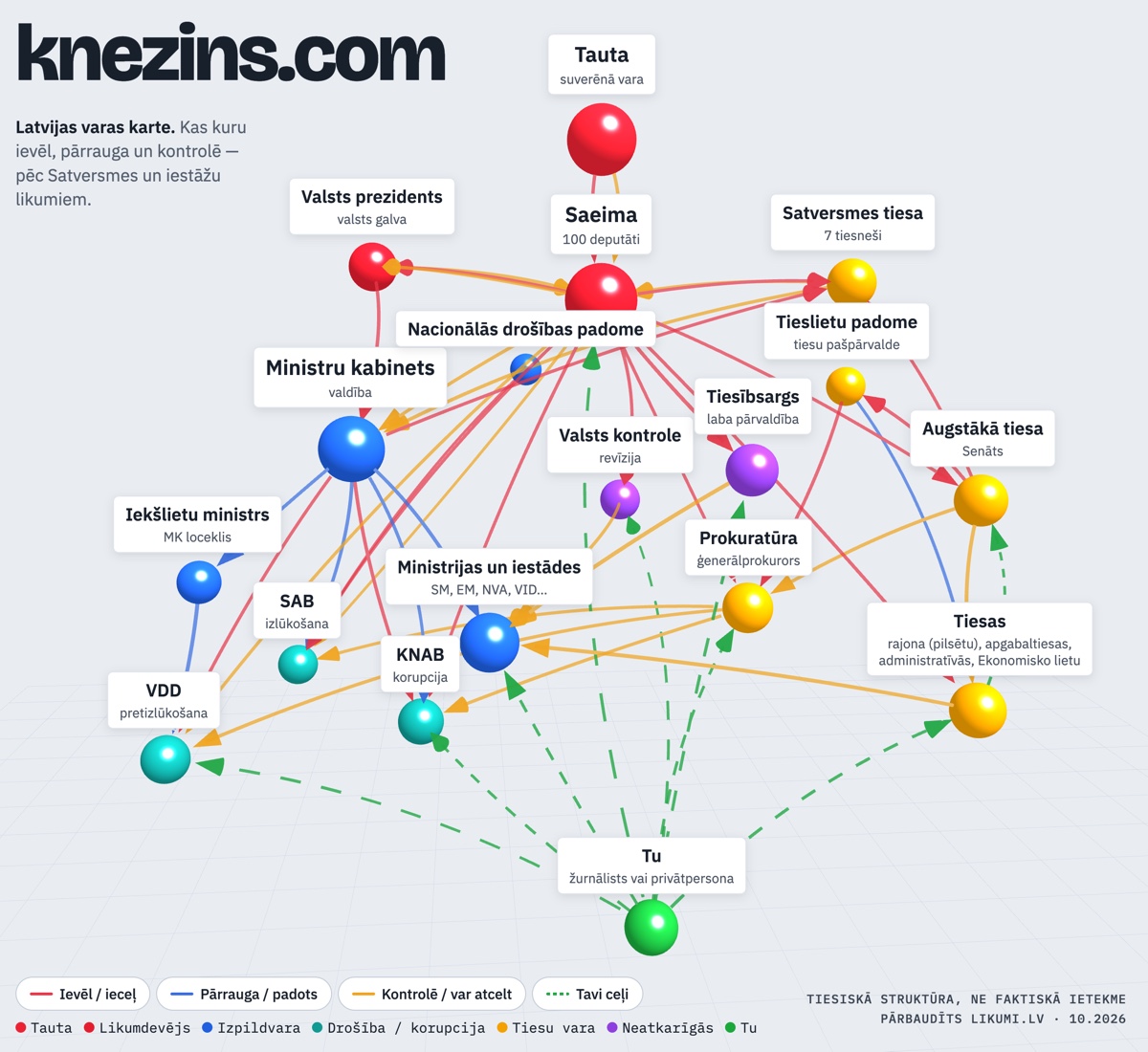
In this case the map points to three routes. The administrative court is the only one that can oblige the ministry to answer. The State Audit Office can audit the funds of state-owned companies and reports its findings to the Saeima, the Cabinet and the prosecution service (State Audit Office Law, Sections 2 and 3). The Saeima's Budget and Finance (Taxation) Committee is the committee that took forward the stabilisation law of 20 August; the new Saeima convenes on 3 November.
- An application to the Administrative District Court against the Ministry of Transport's decision of 2 October to leave the requests unexamined.
- The State Treasury's reply to P9 and the Cabinet's reply to P10 — within the deadline under Section 14 of the Freedom of Information Law (around 23 October).
- 19 October — US court hearing (Dkt. 83, 100, 112) and, most likely, on the final DIP order (Dkt. 98). I will report the outcome.
- Around 23 December and 12 January 2027 — the reorganisation plan and the request to confirm it; by then also the DIP milestones on government equity and exit financing.
- If refusals are not drawn up in the manner prescribed by the Freedom of Information Law, I will use the right under Section 15 of that law to challenge them.
The figures mentioned in the continuation (257, 350, 30, 50, 18 and 594 million euros; 25%) come from public sources and earlier requests; in the requests they are framed as a request to confirm or clarify, not as an assertion. The fact of Chapter 11 follows from the State Treasury's reply of 22 September and the company's public statements. The size of the state's claims (EUR 52.4 and 18.6 million) comes from the State Treasury's reply No. 2026/3-5.19/931 of 2 October.
Documents
All documents listed below are signed with a secure electronic signature and carry a time stamp. Original documents are in Latvian.
- Information request, 13.08.2026 (questions 1–30)
- Supplementary information request, 15.08.2026 (questions 31–38)
- Second supplementary information request, 18.08.2026 (questions 39–44)
- Third supplementary information request, 19.08.2026 (questions 45–49)
- Ministry of Transport letter No. 03.2-02/2521, 20.08.2026
- Objections to the forwarding of the submissions, 22.08.2026
- Procedural request for clarification, 26.08.2026 (P1–P5)
- Ministry of Transport letter No. 03.2-02/2658, 04.09.2026
- Fourth supplementary information request, 06.09.2026 (questions 50–57; P6)
- Fifth supplementary information request, 11.09.2026 (questions 58–61; P7)
- Sixth supplementary information request, 22.09.2026 (questions 62–68; P8)
- Request to the State Treasury for clarification of reply No. 899, 22.09.2026
- State Treasury reply No. 2026/3-5.19/899, 22.09.2026
- State Chancellery letter No. 6.2.2./2026-FIZ-904-3015, 25.09.2026
- State Treasury reply No. 2026/3-5.19/931, 02.10.2026
- State Treasury reply No. 2026/3-5.19/953, 12.10.2026
- Second clarification request to the State Treasury (P9), 02.10.2026
- Information request to the Cabinet of Ministers (P10), 02.10.2026
- Ministry of Transport letter No. 03.2-02/2951, 02.10.2026
Sources
- Saeima. Budget Committee refers the airBaltic financial stabilisation bill to the Saeima — saeima.lv (in Latvian)
- Saeima. Saeima adopts the airBaltic financial stabilisation law (20.08.2026) — saeima.lv (in Latvian)
- Ministry of Transport. Government supports extension of the airBaltic state-loan payment deadline (25.08.2026) — sam.gov.lv (in Latvian)
- Ministry of Transport. Government supports measures to secure airBaltic's financial stability (14.08.2026) — sam.gov.lv (in Latvian)
- LSM.lv. airBaltic changes course: smaller fleet and new financing worth hundreds of millions (11.08.2026)
- LSM.lv. airBaltic bondholders back capitalisation of interest payments (17.08.2026)
- LSM.lv. Saeima agrees to extension of airBaltic state loan and purchase of additional bonds (20.08.2026)
- LSM.lv. Government supports extension of the remaining airBaltic state-loan payment deadline to year-end (25.08.2026)
- Freedom of Information Law — likumi.lv/ta/id/50601
- Law on Submissions (version in force from 01.03.2026) — likumi.lv/ta/id/164501
- AS Air Baltic Corporation. Announcement of an agreement on interim financing of up to EUR 257 million (03.09.2026)
- LSM.lv. airBaltic agrees a loan of up to EUR 257 million (03.09.2026) — lsm.lv
- Dienas Bizness. Government discusses the airBaltic situation again but takes no decisions (08.09.2026) — db.lv
- jauns.lv. airBaltic postpones bondholders' meeting — investors need more time (09.2026) — jauns.lv
- ch-aviation. airBaltic files for Chapter 11 bankruptcy protection (14.09.2026) — ch-aviation.com
- U.S. Bankruptcy Court, Southern District of New York. Case No. 26-12188; case documents — Epiq Corporate Restructuring: dm.epiq11.com/airbaltic
- Same docket: Dkt. 14 — declaration of CFO V. Jakovļevs (14.09.2026); Dkt. 20, 21, 23 — first-day motions and cash forecast; Dkt. 25 — Ad Hoc Group statement; Dkt. 45 — interim DIP order with term sheet (16.09.2026); Dkt. 58 — appointment of the creditors' committee (25.09.2026); Dkt. 79 — DIP credit agreement; Dkt. 83, 98, 100, 112 — matters for the 19.10.2026 hearing; Dkt. 113 — certificate of service (08.10.2026)
- State Treasury reply No. 2026/3-5.19/899, 22.09.2026
- State Treasury reply No. 2026/3-5.19/931, 02.10.2026
- State Treasury reply No. 2026/3-5.19/953, 12.10.2026